
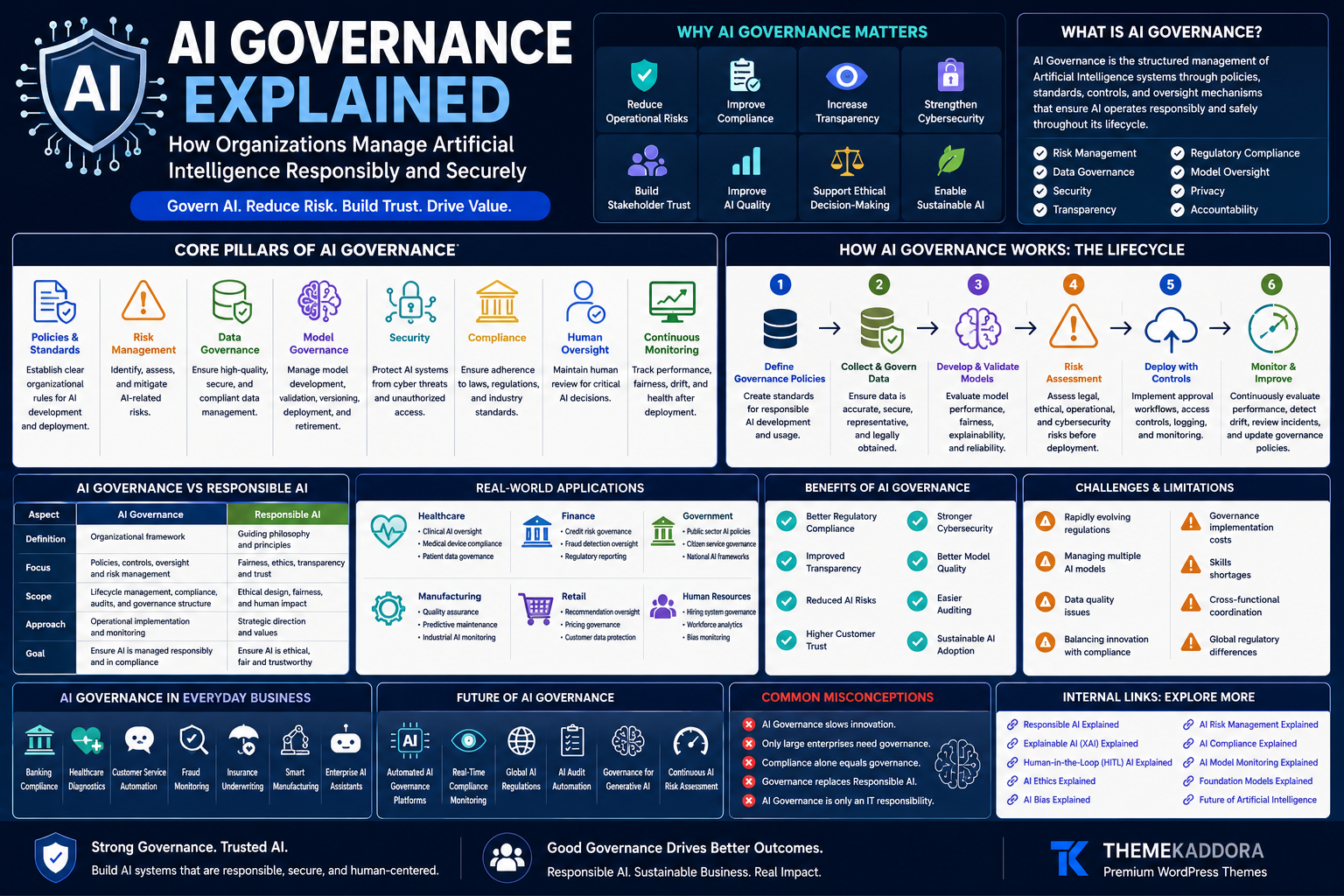
AI Governance Explained: How Organizations Manage Artificial Intelligence Responsibly and Securely
Introduction
Artificial Intelligence is rapidly becoming part of critical business operations, from healthcare diagnostics and financial decision-making to customer support and supply chain optimization. As AI systems become more capable and autonomous, organizations must ensure these technologies are deployed responsibly, securely, and in compliance with legal and ethical standards.
This is where AI Governance becomes essential.
AI Governance is the framework of policies, processes, controls, and oversight that guides how AI systems are designed, developed, deployed, monitored, and managed throughout their lifecycle. It helps organizations balance innovation with accountability while minimizing risks such as bias, security vulnerabilities, privacy issues, and regulatory non-compliance.
Strong governance ensures AI systems remain trustworthy, transparent, and aligned with organizational goals.
What Is AI Governance?
AI Governance is the structured management of Artificial Intelligence systems through policies, standards, controls, and oversight mechanisms that ensure AI operates responsibly and safely.
An effective AI governance program addresses:
Risk management
Regulatory compliance
Data governance
Model oversight
Security
Privacy
Transparency
Accountability
AI Governance provides organizations with a consistent framework for managing AI throughout its lifecycle.
Why AI Governance Matters
As AI systems influence more business decisions, governance becomes increasingly important.
AI Governance helps organizations:
Reduce operational risks
Improve regulatory compliance
Increase transparency
Strengthen cybersecurity
Build stakeholder trust
Improve AI quality
Support ethical decision-making
Enable sustainable AI adoption
Without governance, organizations may face legal, financial, operational, and reputational risks.
Core Pillars of AI Governance
Successful AI Governance typically includes several key components.
Policies and Standards
Establish clear organizational rules for AI development and deployment.
Risk Management
Identify, assess, and mitigate AI-related risks.
Data Governance
Ensure high-quality, secure, and compliant data management.
Model Governance
Manage model development, validation, versioning, deployment, and retirement.
Security
Protect AI systems from cyber threats and unauthorized access.
Compliance
Ensure adherence to applicable laws, regulations, and industry standards.
Human Oversight
Maintain appropriate human review for critical AI decisions.
Continuous Monitoring
Track model performance, fairness, drift, and operational health after deployment.
How AI Governance Works
Organizations generally implement AI Governance through a structured lifecycle.
1. Define Governance Policies
Create standards for responsible AI development and usage.
2. Collect and Govern Data
Ensure datasets are accurate, secure, representative, and legally obtained.
3. Develop and Validate Models
Evaluate model performance, fairness, explainability, and reliability.
4. Risk Assessment
Assess legal, ethical, operational, and cybersecurity risks before deployment.
5. Deploy with Controls
Implement approval workflows, access controls, logging, and monitoring.
6. Monitor and Improve
Continuously evaluate model performance, detect drift, review incidents, and update governance policies as regulations and business needs evolve.
AI Governance vs Responsible AI
AI Governance
Responsible AI
Organizational framework
Guiding philosophy and principles
Policies and controls
Ethical AI practices
Focuses on lifecycle management
Focuses on fairness and trust
Includes compliance and audits
Includes transparency and accountability
Operational implementation
Strategic direction
Responsible AI defines what organizations should achieve, while AI Governance defines how those objectives are implemented and maintained.
Real-World Applications
AI Governance supports organizations across many industries.
Healthcare
Clinical AI oversight
Medical device compliance
Patient data governance
Finance
Credit risk governance
Fraud detection oversight
Regulatory reporting
Government
Public sector AI policies
Citizen service governance
National AI frameworks
Manufacturing
Quality assurance
Predictive maintenance governance
Industrial AI monitoring
Retail
Recommendation system oversight
Pricing governance
Customer data protection
Human Resources
Hiring system governance
Workforce analytics
Bias monitoring
Benefits of AI Governance
Organizations gain numerous advantages.
Benefits include:
Better regulatory compliance
Improved transparency
Reduced AI risks
Higher customer trust
Stronger cybersecurity
Better model quality
Easier auditing
Sustainable AI adoption
AI Governance enables organizations to scale AI responsibly while maintaining operational control.
Challenges and Limitations
Implementing AI Governance can be complex.
Common challenges include:
Rapidly evolving regulations
Managing multiple AI models
Data quality issues
Balancing innovation with compliance
Governance implementation costs
Skills shortages
Cross-functional coordination
Global regulatory differences
Organizations need collaboration across technical, legal, compliance, and business teams to build effective governance programs.
AI Governance in Everyday Business
Many organizations already apply AI Governance in daily operations.
Examples include:
Banking compliance
Healthcare diagnostics
Customer service automation
Fraud monitoring
Insurance underwriting
Smart manufacturing
HR recruitment systems
Enterprise AI assistants
Governance helps ensure these AI systems remain secure, fair, and reliable.
Future of AI Governance
Emerging trends include:
Automated AI governance platforms
Real-time compliance monitoring
Global AI regulations
AI audit automation
Model lifecycle management
Governance for generative AI
Enterprise AI control frameworks
Continuous AI risk assessment
As AI adoption expands, governance will become a core business capability rather than an optional practice.
Common Misconceptions
Several myths surround AI Governance.
Common misconceptions include:
AI Governance slows innovation.
Only large enterprises need governance.
Compliance alone equals governance.
Governance replaces Responsible AI.
AI Governance is only an IT responsibility.
In reality, AI Governance supports innovation by reducing risks and building trust across the organization.
Final Thoughts
AI Governance provides the structure organizations need to develop and manage Artificial Intelligence responsibly. By combining clear policies, strong oversight, continuous monitoring, and effective risk management, businesses can deploy AI systems that are transparent, secure, compliant, and aligned with organizational objectives.
As Artificial Intelligence becomes more deeply integrated into business operations, AI Governance will remain a critical foundation for building trustworthy, scalable, and sustainable AI solutions.
Frequently Asked Questions
What is AI Governance?
AI Governance is the framework of policies, controls, and oversight used to manage Artificial Intelligence systems responsibly throughout their lifecycle.
Why is AI Governance important?
It helps organizations reduce risks, improve compliance, increase transparency, strengthen security, and build trust in AI systems.
Which industries use AI Governance?
Healthcare, finance, manufacturing, retail, government, education, insurance, legal services, and many other sectors rely on AI Governance.
What is the difference between AI Governance and Responsible AI?
Responsible AI defines ethical principles, while AI Governance provides the operational framework to implement, monitor, and enforce those principles.
Is AI Governance only for large organizations?
No. Businesses of all sizes can benefit from governance practices that improve AI quality, security, and accountability.
Comments (0)