
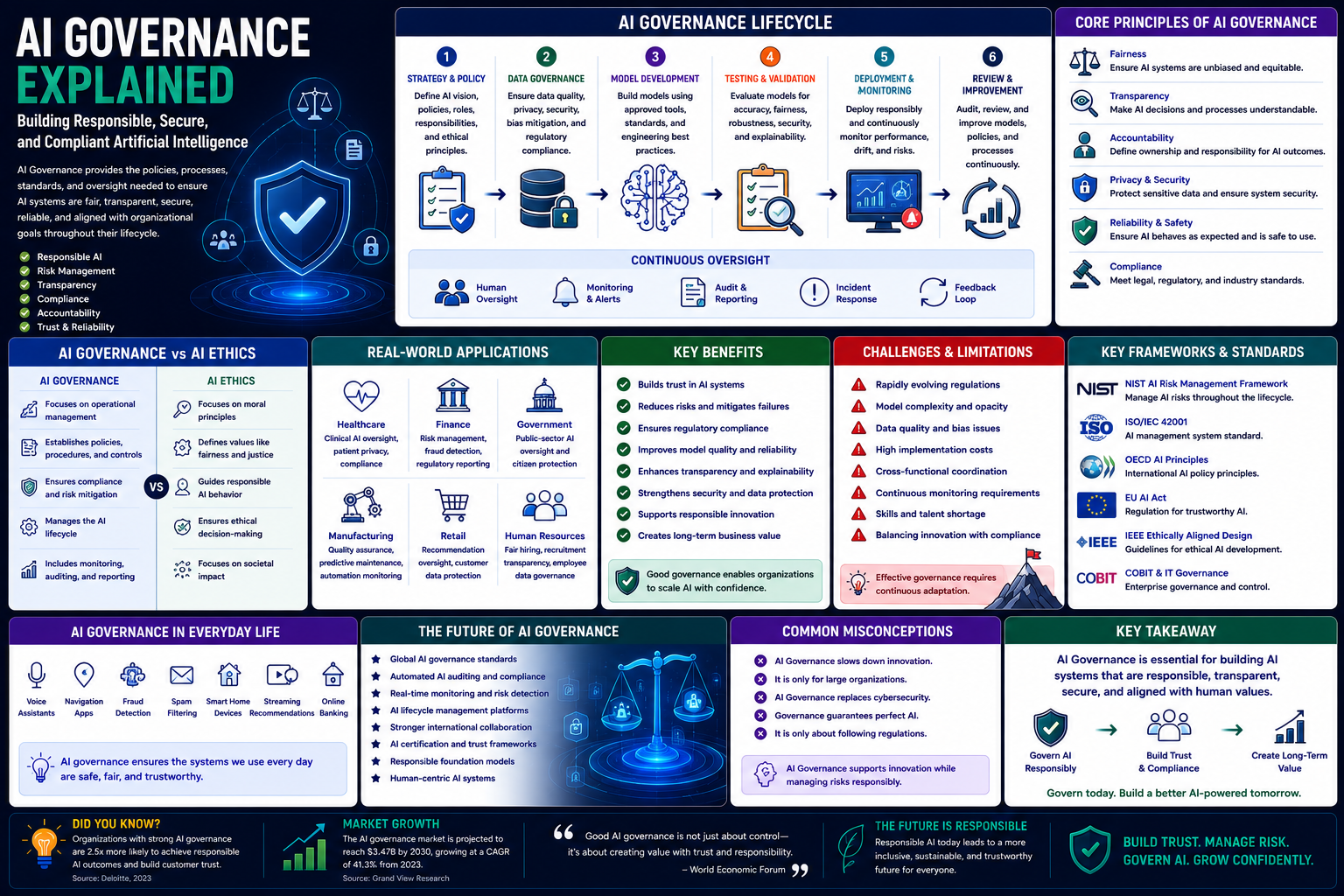
AI Governance Explained: Building Responsible, Secure, and Compliant Artificial Intelligence
Introduction
Artificial Intelligence is becoming a critical part of business operations, healthcare, banking, education, manufacturing, transportation, and government services. AI systems now make recommendations, automate workflows, analyze documents, detect fraud, and assist in complex decision-making.
As AI becomes more powerful, organizations face important questions:
Who is responsible for AI decisions?
How should AI systems be monitored?
How can bias be reduced?
How should AI models be updated?
How can organizations comply with evolving regulations?
These questions are addressed through AI Governance.
AI Governance provides the policies, processes, technologies, and oversight needed to ensure AI systems remain secure, transparent, compliant, and aligned with organizational objectives throughout their lifecycle.
What Is AI Governance?
AI Governance is the framework of policies, controls, standards, and oversight used to manage Artificial Intelligence systems responsibly.
It helps organizations ensure that AI models are:
Fair
Transparent
Secure
Reliable
Compliant
Auditable
Explainable
Accountable
Rather than focusing on model development alone, AI Governance manages the complete lifecycle of AI systems.
Why AI Governance Matters
Without proper governance, AI systems can introduce significant risks.
Examples include:
Algorithmic bias
Privacy violations
Security vulnerabilities
Regulatory non-compliance
Poor model performance
Lack of accountability
Unsafe automation
Reputational damage
AI Governance helps organizations reduce these risks while increasing trust in AI-powered solutions.
How AI Governance Works
Most governance programs follow a structured lifecycle.
1. Strategy and Policy
Organizations define AI policies, objectives, ethical principles, and compliance requirements.
2. Data Governance
Training data is evaluated for:
Quality
Privacy
Security
Accuracy
Bias
Regulatory compliance
3. Model Development
AI models are built following engineering standards, documentation requirements, and validation procedures.
4. Testing and Validation
Models are evaluated for:
Accuracy
Fairness
Robustness
Explainability
Security
Performance
5. Deployment and Monitoring
After deployment, organizations continuously monitor:
Model drift
Bias
Security threats
Compliance
Performance metrics
Regular updates ensure AI systems remain reliable over time.
Core Components of AI Governance
Effective governance includes several essential elements.
Policies
Rules governing AI development and usage.
Risk Management
Identifying and mitigating AI-related risks.
Compliance
Meeting legal and industry requirements.
Documentation
Maintaining clear records of model development, testing, and deployment.
Human Oversight
Ensuring critical AI decisions involve appropriate human review.
Monitoring
Tracking model behavior, performance, and reliability after deployment.
AI Governance vs AI Ethics
AI Governance
AI Ethics
Focuses on operational management
Focuses on moral principles
Establishes policies and controls
Defines ethical values
Ensures compliance
Promotes fairness
Manages AI lifecycle
Guides responsible AI behavior
Includes monitoring and auditing
Encourages transparency and accountability
Both disciplines work together to support trustworthy AI.
Real-World Applications
AI Governance is important across many industries.
Healthcare
Clinical AI oversight
Patient privacy
Medical AI compliance
Finance
Credit risk management
Fraud monitoring
Regulatory reporting
Government
Public-sector AI oversight
Citizen data protection
Transparent decision-making
Manufacturing
AI quality assurance
Predictive maintenance governance
Industrial automation monitoring
Retail
Personalized recommendation oversight
Customer data protection
Inventory optimization
Human Resources
Fair hiring systems
Recruitment transparency
Employee data governance
Benefits of AI Governance
Organizations benefit from governance in many ways.
Benefits include:
Increased trust
Better regulatory compliance
Improved transparency
Reduced operational risk
Better AI quality
Continuous monitoring
Stronger security
Responsible AI adoption
Good governance enables organizations to scale AI confidently.
Challenges and Limitations
AI Governance also presents challenges.
These include:
Rapid technological change
Global regulatory differences
Model complexity
Resource requirements
Cross-functional coordination
Data quality issues
Monitoring costs
Skills shortages
Organizations must continuously adapt governance strategies as AI evolves.
AI Governance in Everyday Life
AI Governance supports many technologies people use daily.
Examples include:
Banking systems
Healthcare applications
Navigation platforms
Voice assistants
AI chatbots
Smart devices
Recommendation engines
Autonomous systems
Governance helps ensure these systems remain safe, reliable, and accountable.
Future of AI Governance
Future developments include:
Global AI governance standards
Automated AI auditing
Real-time compliance monitoring
AI lifecycle management platforms
Responsible foundation models
Industry-specific governance frameworks
AI certification programs
Stronger international collaboration
Governance will become a fundamental requirement for enterprise AI deployment.
Common Misconceptions
Several myths surround AI Governance.
Common misconceptions include:
AI Governance slows innovation.
Governance only applies to large companies.
AI Governance replaces cybersecurity.
AI Governance guarantees perfect AI.
Governance is only about regulations.
In reality, AI Governance supports responsible innovation while helping organizations manage risk effectively.
Final Thoughts
AI Governance is becoming a cornerstone of responsible Artificial Intelligence. As AI systems become more integrated into critical business operations and public services, organizations need structured frameworks to manage risks, maintain transparency, and ensure compliance.
By combining strong policies, continuous monitoring, human oversight, and ethical principles, AI Governance helps organizations deploy AI with confidence while protecting users, data, and long-term business value.
Frequently Asked Questions
What is AI Governance?
AI Governance is the framework of policies, controls, and oversight used to manage AI systems responsibly throughout their lifecycle.
Why is AI Governance important?
It helps organizations reduce risks, improve transparency, ensure compliance, and build trustworthy AI systems.
What is the difference between AI Governance and AI Ethics?
AI Ethics defines the principles of responsible AI, while AI Governance implements policies, processes, and monitoring to put those principles into practice.
Which industries use AI Governance?
Healthcare, finance, government, manufacturing, retail, education, telecommunications, and many others.
Does every organization need AI Governance?
Any organization deploying AI at scale benefits from governance to ensure reliability, accountability, and regulatory compliance.
Comments (0)