
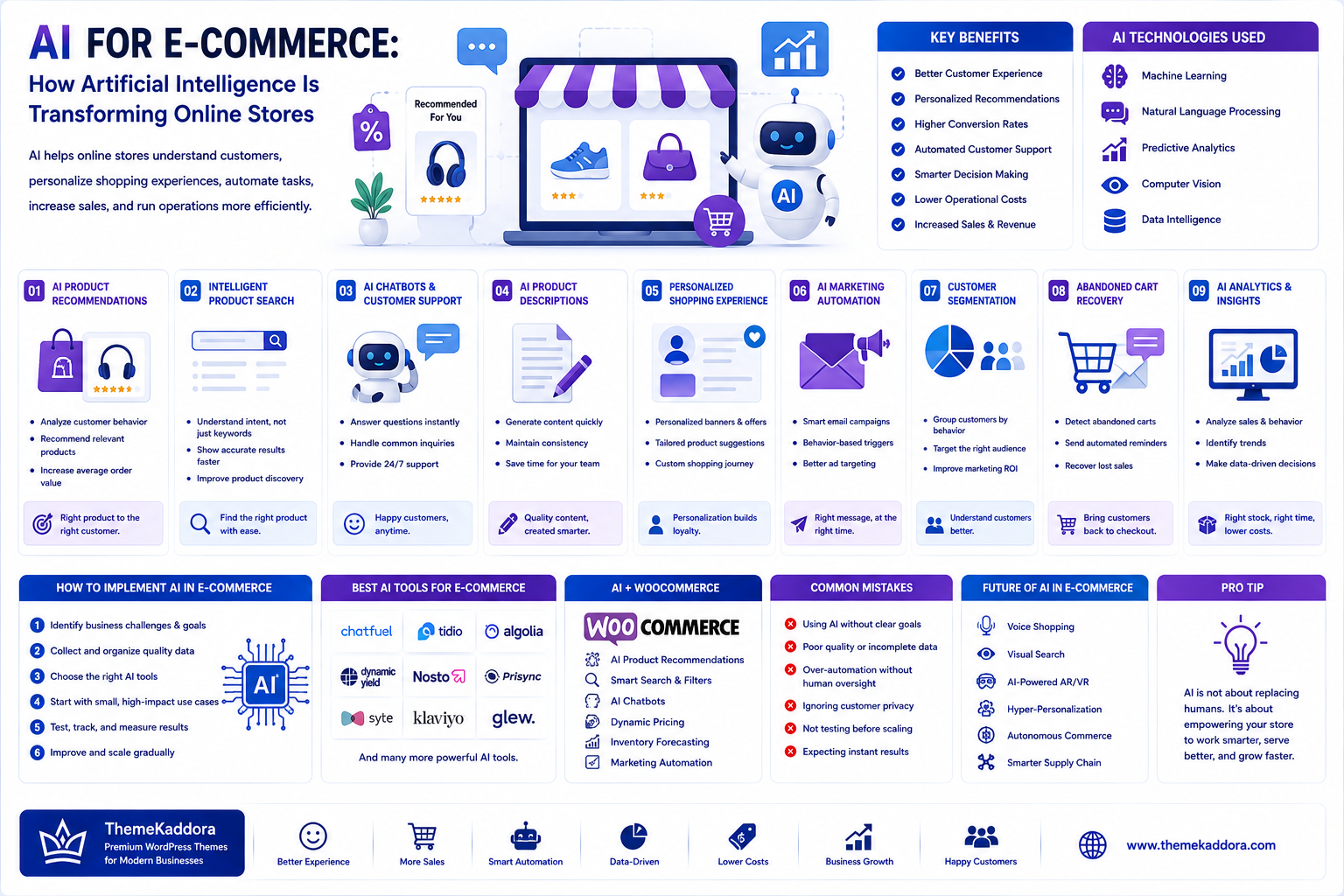
AI for E-Commerce: How Artificial Intelligence Is Transforming Online Stores
Introduction
E-commerce is changing rapidly as customers expect faster service, personalized experiences, relevant recommendations, and convenient shopping journeys.
For online businesses, meeting these expectations manually can become difficult as the number of customers, products, and interactions increases.
This is where AI for e-commerce can provide significant opportunities.
Artificial intelligence can help online stores understand customer behavior, improve product discovery, automate customer support, personalize marketing, analyze sales data, and streamline everyday operations.
AI is not simply another technology added to an online store. When implemented correctly, it can become part of the entire customer journey.
From the first website visit to product discovery, purchase, customer support, and retention, AI can help businesses create smarter e-commerce experiences.
What Is AI for E-Commerce?
AI for e-commerce refers to using artificial intelligence technologies to improve online shopping and business operations.
AI can analyze customer information, recognize patterns, understand language, generate content, and support automated decision-making.
Online stores can use AI for:
Product recommendations
Customer support
Personalized shopping
Product descriptions
Intelligent search
Marketing
Sales forecasting
Customer segmentation
Review analysis
Inventory insights
Fraud detection
Email automation
The right application depends on the size, products, customers, and objectives of the online business.
Why AI Is Important for Online Stores
Customers have more choices than ever.
A visitor can leave one online store and find another product within seconds. This makes the customer experience extremely important.
AI can help online businesses create a more convenient shopping journey by understanding what customers are searching for and providing more relevant information.
For example, AI can help answer:
What is this customer looking for?
Which products may interest them?
What questions are preventing them from purchasing?
Which products are frequently purchased together?
What problems are customers experiencing?
These insights can help businesses improve both sales and customer satisfaction.
AI Product Recommendations
Product recommendations are one of the most visible uses of AI in e-commerce.
Traditional recommendation systems may rely on simple categories or predefined rules.
AI can analyze multiple signals, including:
Previous purchases
Browsing behavior
Search activity
Product interactions
Customer preferences
Similar customer behavior
The system can then recommend products that may be relevant to an individual shopper.
For example:
Customer Views Laptop
↓
AI Analyzes Interest
↓
Recommended Accessories
↓
Customer Discovers Relevant Products
This can improve product discovery and create opportunities for additional sales.
AI-Powered Product Search
Large online stores can contain thousands of products.
Finding the right product can become difficult when customers do not know the exact product name.
AI-powered search can understand the meaning behind a search query rather than relying only on exact keywords.
For example, a customer might search for:
"comfortable shoes for long walks"
Instead of requiring the customer to know a specific product name, an intelligent search system can interpret the customer's intent and return relevant products.
This can make product discovery easier and create a smoother shopping experience.
AI Chatbots for E-Commerce
Online shoppers often have questions before making a purchase.
They may want to know about:
Product features
Size information
Shipping details
Return policies
Availability
Compatibility
Delivery information
An AI chatbot can provide answers quickly.
A typical workflow can look like:
Customer Question
↓
AI Understands Intent
↓
Product or Store Information
↓
AI Response
↓
Purchase or Human Support
This can reduce customer waiting times and help businesses manage repetitive questions.
However, AI should not provide information it cannot verify. Important customer requests should have a clear path to human assistance.
AI for Product Descriptions
Online stores may have hundreds or thousands of products.
Creating every product description manually can take considerable time.
AI can help generate initial product descriptions using information such as:
Product specifications
Features
Benefits
Materials
Dimensions
Target audience
Businesses can then review and edit the content to ensure accuracy and maintain their brand voice.
AI should support the product-content workflow rather than automatically publishing unverified information.
AI-Powered Personalization
Every customer is different.
A first-time visitor may need educational information, while a returning customer may already know what they want.
AI can help personalize online shopping experiences based on customer behavior and interests.
For example:
First-Time Visitor
→ Popular Products
Returning Customer
→ Relevant Recommendations
Previous Buyer
→ Complementary Products
High-Intent Visitor
→ Product Comparison or Assistance
Personalization can make an e-commerce website more relevant to individual customers.
AI for E-Commerce Marketing
AI can also improve online store marketing.
Businesses can use AI to assist with:
Email campaigns
Social media content
Product promotions
Customer segmentation
Retargeting strategies
SEO
Content marketing
Campaign analysis
Instead of sending the same promotional message to every customer, an AI-assisted system can help create different campaigns for different customer groups.
This can make marketing more relevant and potentially improve engagement.
AI for Customer Segmentation
Customer segmentation involves dividing customers into groups based on characteristics or behavior.
AI can analyze customer data and identify patterns that may not be obvious through manual analysis.
Possible customer groups include:
New customers
Repeat customers
High-value customers
Inactive customers
Discount-focused shoppers
Product-specific customers
Businesses can then create different strategies for each group.
For example:
New Customer
→ Welcome Campaign
Repeat Customer
→ Loyalty Campaign
Inactive Customer
→ Re-Engagement Campaign
This can create a more personalized customer journey.
AI for Abandoned Cart Recovery
Abandoned carts are a common challenge for online stores.
Customers may add products to their carts and leave without completing the purchase.
AI can help businesses analyze abandoned-cart patterns and support automated recovery campaigns.
A workflow could look like:
Customer Adds Product
↓
Customer Leaves Website
↓
AI Identifies Abandoned Cart
↓
Personalized Reminder
↓
Customer Returns
↓
Purchase
AI can also help determine whether a customer needs additional product information instead of simply receiving another discount.
AI for Customer Reviews
Customer reviews contain valuable information about products and customer experiences.
Instead of manually reading hundreds of reviews, businesses can use AI to identify common themes.
AI can help identify:
Frequently praised features
Common complaints
Product quality concerns
Delivery issues
Frequently requested improvements
For example, if many customers mention the same product problem, the business can investigate the issue.
This turns customer reviews into a source of product and business intelligence.
AI for E-Commerce Analytics
Online stores generate large amounts of data.
This can include:
Website traffic
Product views
Conversion rates
Sales
Customer behavior
Cart activity
Marketing performance
AI can help identify patterns within this information.
For example, an online store might discover that a particular product receives many views but few purchases.
This could indicate potential issues with:
Pricing
Product information
Images
Customer trust
Shipping costs
Product positioning
AI can help identify these patterns, while business owners make the final decisions.
AI for Inventory and Demand Forecasting
Inventory management can become difficult as an e-commerce business grows.
Too much inventory can increase storage costs, while too little inventory can result in missed sales.
AI can analyze historical sales and other business data to help estimate future demand.
For example:
Historical Sales
Seasonal Patterns
Current Demand
Customer Behavior
↓
Demand Forecast
This can help businesses make more informed inventory decisions.
AI forecasts should still be treated as decision-support tools rather than guaranteed predictions.
AI for WordPress and WooCommerce Stores
WordPress and WooCommerce provide a flexible foundation for online businesses.
AI can be integrated into WooCommerce websites through plugins, external services, APIs, and custom development.
Possible applications include:
AI product recommendations
Customer chatbots
Product description assistance
Intelligent search
Marketing automation
Customer segmentation
Review analysis
Personalized shopping experiences
For small businesses, ready-made plugins may provide a practical starting point.
Larger businesses may require custom AI integrations that connect their store with CRM, inventory, analytics, and customer data systems.
How to Start Using AI in an Online Store
Businesses do not need to introduce every AI feature at once.
The best approach is to identify one genuine problem.
Ask:
Where are customers experiencing friction?
For example:
Customers cannot find products
→ Improve AI-powered search.
Customers ask repetitive questions
→ Consider an AI support assistant.
Customers leave products in carts
→ Improve abandoned-cart workflows.
Marketing feels generic
→ Introduce customer segmentation and personalization.
Product management takes too much time
→ Consider AI-assisted content workflows.
The business problem should come before the technology.
Choosing the Right AI E-Commerce Tools
Different businesses require different AI solutions.
Depending on the problem, an online store might consider:
AI chatbots
AI product recommendation systems
E-commerce automation tools
AI analytics platforms
Marketing automation
WordPress AI plugins
WooCommerce integrations
Custom AI APIs
Before selecting a solution, businesses should evaluate:
Integration
Can it work with the existing e-commerce platform?
Accuracy
Can the system provide reliable information?
Privacy
How is customer data collected and processed?
Performance
Will the technology affect website speed?
Cost
Does the expected value justify the investment?
Scalability
Can the solution support the business as it grows?
The best AI tool is the one that solves a real problem without creating unnecessary complexity.
How to Implement AI in an E-Commerce Business
A practical implementation strategy can follow several steps.
Step 1: Identify One Problem
Choose a specific challenge, such as customer support, product discovery, or abandoned carts.
Step 2: Collect the Required Data
Determine what information the AI system needs.
This could include:
Product information
Customer behavior
Sales data
Support conversations
Website interactions
Step 3: Choose the Right Solution
Select a suitable plugin, platform, AI service, or custom integration.
Step 4: Test Before Scaling
Start with a small part of the store and measure the results.
Step 5: Monitor the System
Review AI outputs and customer interactions regularly.
Step 6: Expand Gradually
Once the first AI workflow provides measurable value, introduce AI into another area of the business.
Building an AI-Powered E-Commerce Customer Journey
AI can support almost every stage of the online shopping experience.
Discovery
AI-assisted SEO and content can help attract potential customers.
↓
Product Search
AI-powered search can help visitors find relevant products.
↓
Consideration
AI chatbots can answer product questions.
↓
Purchase
Personalized recommendations and useful product information can support buying decisions.
↓
Post-Purchase
AI can assist with customer support, recommendations, and follow-up communication.
↓
Retention
Personalized campaigns can encourage repeat purchases.
This creates a connected customer journey rather than isolated AI features.
Common AI E-Commerce Mistakes
AI can provide significant benefits, but poor implementation can create new problems.
Using AI Without Accurate Data
AI recommendations and responses depend on reliable information.
Over-Personalization
Customers may become uncomfortable when personalization feels excessive or intrusive.
Ignoring Privacy
Businesses need to handle customer information responsibly.
Publishing Incorrect Product Information
AI-generated product descriptions should be reviewed for accuracy.
Automating Customer Support Completely
Some customer situations require human assistance.
Adding Too Many AI Features
More technology does not automatically create a better shopping experience.
The best AI implementation is usually the one that removes friction for customers.
Benefits of AI for E-Commerce Businesses
When implemented strategically, AI can provide several benefits.
Better Customer Experience
Customers can receive faster answers and more relevant recommendations.
Increased Efficiency
Repetitive tasks can be automated.
Improved Personalization
Businesses can create experiences based on customer behavior and interests.
Better Business Insights
AI can identify patterns in customer and sales data.
Smarter Marketing
Businesses can create more targeted campaigns.
Improved Product Discovery
Intelligent search and recommendations can help customers find relevant products faster.
Scalability
AI can help businesses manage increasing customer interactions without adding the same amount of manual work.
The Future of AI in E-Commerce
E-commerce is moving toward increasingly intelligent and personalized shopping experiences.
Future online stores may increasingly combine:
AI Search
Personalization
Conversational Shopping
Automated Marketing
Predictive Analytics
Human Support
This could transform the online store from a static product catalog into an intelligent shopping environment.
Customers may increasingly interact with stores through conversations rather than traditional menus and filters.
Instead of searching through dozens of products, customers could explain what they need and receive relevant recommendations.
Conclusion
AI for e-commerce is changing how online stores attract customers, present products, provide support, and increase sales.
From intelligent product search and personalized recommendations to AI chatbots, automated marketing, customer segmentation, review analysis, and demand forecasting, artificial intelligence can influence almost every stage of the e-commerce journey.
However, successful AI adoption is not about adding as many AI features as possible.
The most effective approach is to identify a genuine customer or business problem and then choose technology that solves it.
An online store can start with a single workflow, measure its performance, improve the experience, and gradually introduce AI into other areas.
For WordPress and WooCommerce businesses, AI also creates opportunities to turn traditional websites into more intelligent shopping platforms.
The future of e-commerce is not simply about selling products online. It is about creating smarter, faster, more personalized, and more helpful shopping experiences.
When AI technology is combined with accurate data, strong business strategy, human oversight, and a customer-first approach, it can become a powerful tool for building and scaling modern online businesses.
Frequently Asked Questions About AI for E-Commerce
1. What is AI for e-commerce?
AI for e-commerce is the use of artificial intelligence to improve online shopping and business operations. It can support product recommendations, customer service, personalization, marketing, analytics, search, and automation.
2. How can AI help an online store?
AI can help an online store improve product discovery, personalize customer experiences, answer common questions, automate marketing, analyze customer behavior, create product content, and support business decisions.
3. Can AI increase e-commerce sales?
AI can potentially support higher sales by improving product recommendations, personalization, search, customer support, and marketing. Results depend on implementation, product quality, pricing, customer demand, and the overall shopping experience.
4. How does AI personalize e-commerce websites?
AI can analyze signals such as browsing behavior, previous purchases, product interactions, and customer preferences to provide more relevant products, content, offers, or recommendations.
5. How can AI improve product recommendations?
AI can analyze customer behavior and identify relationships between products and customer interests. It can then recommend products that may be relevant to a particular shopper.
6. Can AI be used for WooCommerce?
Yes. AI can be integrated with WooCommerce through plugins, APIs, external AI services, automation platforms, and custom development. Possible applications include chatbots, product recommendations, content assistance, analytics, and personalization.
7. Can AI write e-commerce product descriptions?
Yes. AI can create initial product descriptions from specifications and product information. However, businesses should review AI-generated descriptions for accuracy, originality, brand voice, and compliance before publishing them.
8. How can AI help with e-commerce customer support?
AI chatbots and assistants can answer frequently asked questions, provide product information, help customers navigate a website, and direct complex requests to human support teams.
Comments (0)