
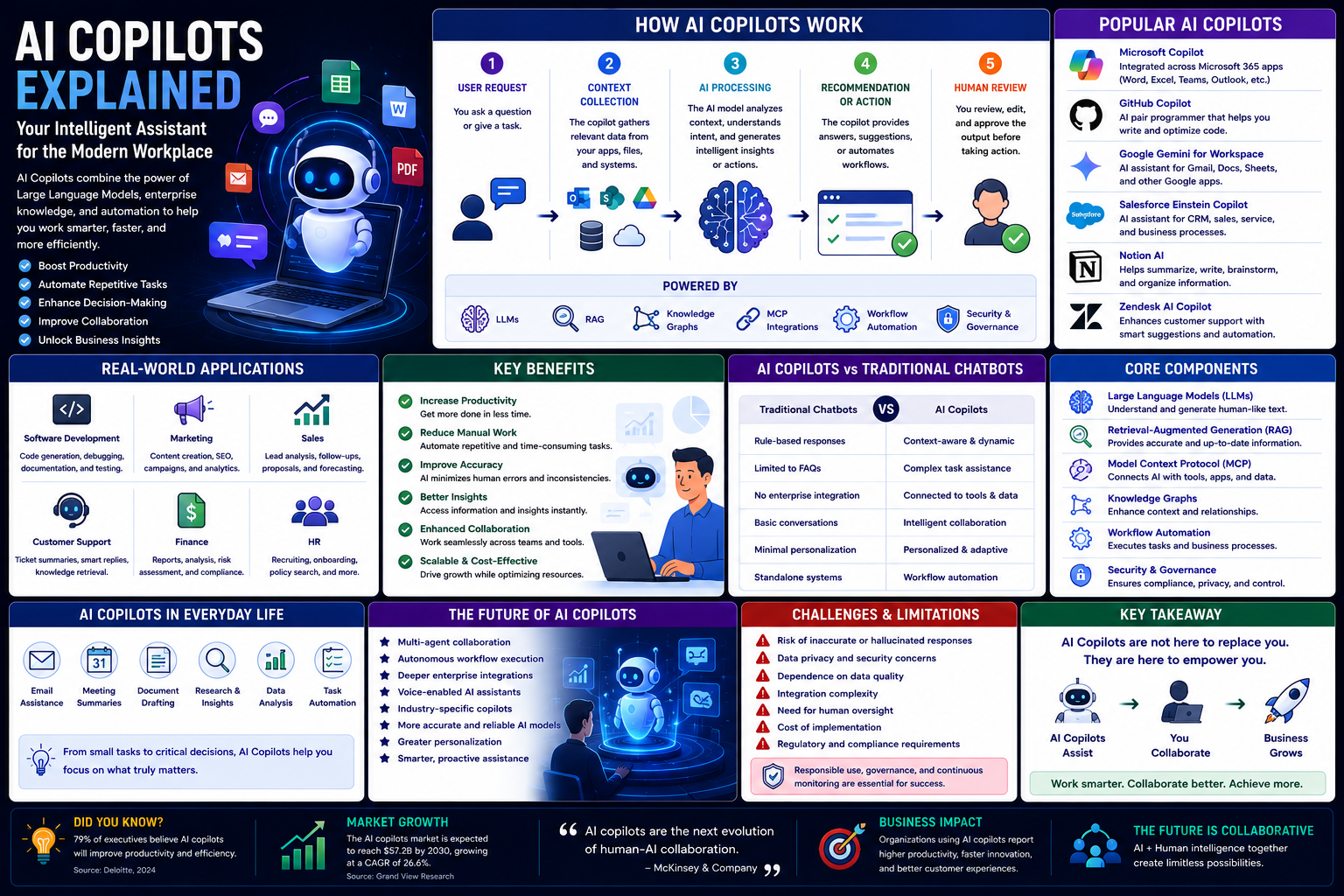
AI Copilots Explained: How Intelligent Assistants Are Transforming Work and Productivity
Introduction
Artificial Intelligence has evolved far beyond answering simple questions. Modern AI systems can now write emails, summarize meetings, generate reports, analyze documents, create software code, automate workflows, and assist professionals with complex daily tasks.
These intelligent assistants are commonly known as AI Copilots.
Rather than replacing people, AI copilots work alongside them by providing suggestions, automating repetitive work, retrieving information, and accelerating decision-making. They combine Large Language Models (LLMs), Retrieval-Augmented Generation (RAG), enterprise knowledge, and workflow automation to become valuable digital collaborators.
From software development and customer support to healthcare, finance, education, and marketing, AI copilots are transforming how organizations improve productivity and innovation.
What Are AI Copilots?
An AI Copilot is an intelligent assistant powered by Artificial Intelligence that helps users perform tasks, generate content, retrieve information, and automate workflows.
Unlike basic chatbots, AI copilots understand context, interact with business tools, and assist with complex activities.
AI copilots can:
Answer questions
Draft documents
Write code
Summarize meetings
Analyze data
Search enterprise knowledge
Create presentations
Automate repetitive work
They are designed to augment human capabilities rather than replace them.
Why AI Copilots Matter
Modern professionals spend significant time on repetitive administrative tasks.
AI copilots help by:
Increasing productivity
Reducing manual work
Improving collaboration
Accelerating decision-making
Enhancing creativity
Supporting knowledge discovery
Automating routine workflows
Improving customer experiences
Organizations increasingly use AI copilots to empower employees across departments.
How AI Copilots Work
Most AI copilots follow a structured workflow.
1. User Request
A user provides a prompt or asks a question.
Examples include:
Write an email
Generate code
Summarize a report
Analyze sales data
Create a presentation
2. Context Collection
The copilot gathers relevant information from:
Documents
Enterprise databases
Calendars
Emails
APIs
CRM systems
Knowledge bases
3. AI Processing
Large Language Models interpret the request, combine context, and generate an appropriate response.
Technologies commonly involved include:
LLMs
RAG
Vector databases
Knowledge graphs
MCP integrations
4. Recommendation or Action
The copilot may:
Generate text
Execute workflows
Retrieve documents
Schedule meetings
Create reports
Produce code
Answer questions
5. Human Review
Users review, edit, and approve the final output before taking action.
Human oversight remains an essential part of responsible AI use.
Core Components of AI Copilots
Several technologies work together.
Large Language Models (LLMs)
Generate natural language responses.
Retrieval-Augmented Generation (RAG)
Retrieves accurate enterprise information.
Model Context Protocol (MCP)
Connects AI to business tools and applications.
Knowledge Graphs
Provide contextual relationships between data.
Workflow Automation
Executes repetitive business processes.
Security and Governance
Protect sensitive data while enforcing organizational policies.
AI Copilots vs Traditional Chatbots
Traditional Chatbots
AI Copilots
Scripted conversations
Context-aware assistance
Limited responses
Dynamic reasoning
Standalone applications
Connected to enterprise tools
Basic FAQs
Complex task execution
Minimal personalization
Personalized recommendations
AI copilots offer significantly broader capabilities than conventional chatbots.
Real-World Applications
AI copilots are transforming many industries.
Software Development
Code generation
Bug detection
Documentation
Testing assistance
Healthcare
Clinical documentation
Patient summaries
Medical research
Finance
Financial reporting
Risk analysis
Fraud investigation
Marketing
Content creation
Campaign planning
SEO optimization
Customer Support
Ticket summaries
Automated responses
Knowledge retrieval
Human Resources
Recruitment assistance
Policy search
Employee onboarding
Benefits of AI Copilots
AI copilots provide many advantages.
Benefits include:
Higher productivity
Faster decision-making
Better knowledge access
Improved collaboration
Reduced repetitive work
Enhanced creativity
Better customer service
Scalable business automation
Organizations use AI copilots to improve efficiency across teams.
Challenges and Limitations
Despite their capabilities, AI copilots have limitations.
These include:
Hallucinated responses
Data privacy concerns
Security risks
Context limitations
Regulatory compliance
Human oversight requirements
Integration complexity
Cost of deployment
Proper governance and validation remain essential.
AI Copilots in Everyday Life
Many people already interact with AI copilots.
Examples include:
Office productivity assistants
Coding assistants
Email writing assistants
Meeting summarization tools
CRM copilots
Customer service assistants
Personal productivity tools
Research assistants
AI copilots are becoming part of everyday digital work.
Future of AI Copilots
Future developments include:
Multi-agent collaboration
Personalized enterprise assistants
Autonomous workflow execution
Voice-enabled copilots
Industry-specific AI assistants
Multimodal collaboration
Better reasoning capabilities
Smarter business automation
AI copilots are expected to become standard workplace companions across industries.
Common Misconceptions
Several myths surround AI copilots.
Common misconceptions include:
AI copilots replace employees.
AI copilots always produce perfect answers.
They only work for programmers.
AI copilots require no human review.
Small businesses cannot benefit from AI copilots.
In reality, AI copilots are designed to augment human expertise, not replace it.
Final Thoughts
AI copilots are redefining how people interact with technology by combining advanced language models, enterprise knowledge, workflow automation, and intelligent reasoning into practical digital assistants. Rather than replacing professionals, these systems empower them to work faster, make better decisions, and focus on higher-value activities.
As organizations continue investing in Artificial Intelligence, AI copilots will become a central component of the modern digital workplace, helping individuals and teams collaborate more effectively while driving innovation and productivity.
Frequently Asked Questions
What is an AI Copilot?
An AI Copilot is an intelligent assistant that helps users perform tasks, retrieve information, generate content, and automate workflows using Artificial Intelligence.
How do AI copilots differ from chatbots?
AI copilots provide context-aware assistance, integrate with enterprise systems, and support complex workflows rather than simple scripted conversations.
Which industries use AI copilots?
Healthcare, finance, software development, marketing, customer support, education, manufacturing, retail, and many others.
Do AI copilots replace human workers?
No. AI copilots are designed to enhance productivity by assisting users, while humans remain responsible for oversight and final decisions.
Why are AI copilots important?
They improve productivity, automate repetitive work, enhance decision-making, and provide faster access to organizational knowledge.
Comments (0)