
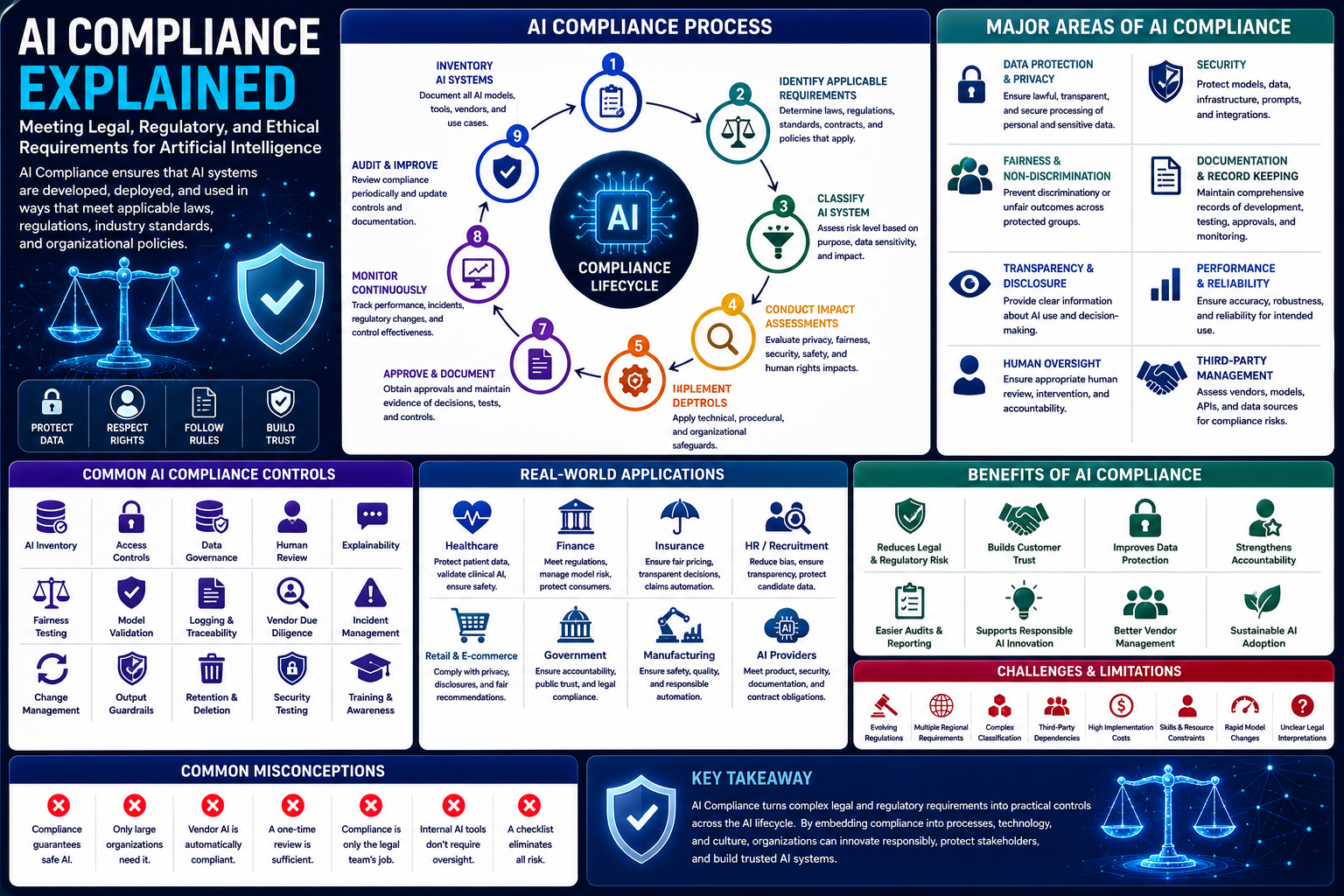
AI Compliance Explained: How Organizations Meet Legal, Regulatory, and Ethical Requirements for Artificial Intelligence
Introduction
Artificial Intelligence is increasingly used to support decisions, automate workflows, generate content, manage customer interactions, and analyze sensitive information. As organizations deploy AI across business operations, they must ensure these systems comply with applicable laws, regulations, contractual obligations, industry standards, and internal policies.
An AI system may create compliance concerns when it processes personal data, makes high-impact decisions, produces discriminatory outcomes, lacks transparency, or operates without appropriate oversight.
This makes AI Compliance an essential component of responsible AI adoption.
AI Compliance helps organizations translate legal and regulatory requirements into practical controls for data collection, model development, deployment, monitoring, documentation, and incident response. It ensures that AI systems are not only technically capable but also lawful, accountable, secure, and appropriately governed.
What Is AI Compliance?
AI Compliance is the practice of ensuring Artificial Intelligence systems follow applicable:
Laws
Regulations
Industry standards
Contractual obligations
Internal policies
Ethical commitments
Data protection requirements
Security requirements
It applies throughout the AI lifecycle, from initial planning and data collection to deployment, monitoring, auditing, and retirement.
AI Compliance helps organizations demonstrate that they understand their obligations and have implemented reasonable controls to meet them.
Why AI Compliance Matters
Non-compliant AI systems can create serious consequences.
Potential outcomes include:
Regulatory investigations
Financial penalties
Legal claims
Product restrictions
Operational disruption
Customer complaints
Contract violations
Reputational damage
Loss of stakeholder trust
AI Compliance helps organizations reduce these risks while supporting responsible innovation.
Major Areas of AI Compliance
AI Compliance includes several interconnected areas.
Data Protection and Privacy
Organizations must manage personal and sensitive data lawfully and securely.
Key considerations include:
Consent
Purpose limitation
Data minimization
Retention
Access rights
Security
Cross-border transfers
Fairness and Non-Discrimination
AI systems should not produce unlawful or unjust discriminatory outcomes.
Transparency
Users may need to know when they are interacting with AI or when automated systems influence important decisions.
Human Oversight
High-impact decisions may require human review, escalation, or intervention.
Documentation
Organizations should maintain records explaining how AI systems were developed, tested, approved, and monitored.
Security
AI models, data, infrastructure, prompts, APIs, and integrations must be protected from unauthorized access and manipulation.
Model Performance
Systems must be tested for accuracy, robustness, reliability, and suitability for their intended purpose.
Third-Party Management
External models, APIs, datasets, vendors, and cloud services must be assessed for compliance risks.
How the AI Compliance Process Works
Most organizations follow a structured compliance lifecycle.
1. Inventory AI Systems
Create a record of AI models, tools, vendors, use cases, owners, and affected users.
2. Identify Applicable Requirements
Determine which laws, standards, contracts, and policies apply to each system.
3. Classify the AI System
Assess the system based on factors such as:
Purpose
Industry
Data sensitivity
Decision impact
Autonomy
User population
Geographic use
4. Conduct Impact Assessments
Evaluate privacy, fairness, security, safety, transparency, and human-rights impacts.
5. Implement Controls
Apply technical, procedural, contractual, and organizational safeguards.
6. Validate Before Deployment
Test the system for compliance, performance, fairness, security, and reliability.
7. Approve and Document
Obtain required approvals and maintain evidence of decisions, tests, controls, and limitations.
8. Monitor Continuously
Track performance, incidents, complaints, regulatory changes, model drift, and control effectiveness.
9. Audit and Improve
Review compliance periodically and update controls when systems or requirements change.
AI Compliance vs AI Governance
AI Compliance
AI Governance
Focuses on meeting requirements
Provides overall oversight
Interprets laws and standards
Defines roles and policies
Maintains compliance evidence
Coordinates the AI lifecycle
Supports regulatory reporting
Supports strategic accountability
Tests adherence to obligations
Establishes decision-making structures
AI Governance creates the organizational framework, while AI Compliance ensures specific obligations are identified and satisfied.
AI Compliance vs AI Risk Management
AI Compliance
AI Risk Management
Focuses on legal and policy obligations
Focuses on uncertainty and potential harm
Determines mandatory requirements
Prioritizes risk based on likelihood and impact
Produces evidence of adherence
Selects controls to reduce exposure
Supports inspections and audits
Supports operational decision-making
Addresses non-compliance
Addresses broader technical and business risk
The two disciplines work together. A system can be legally compliant yet still create operational or reputational risks that require additional controls.
Common AI Compliance Controls
Organizations use multiple safeguards to support compliance.
AI System Inventory
Maintain a current record of deployed and experimental AI systems.
Data Governance
Document data sources, permissions, quality, provenance, retention, and usage limitations.
Role-Based Access Control
Limit access to models, data, prompts, configurations, and deployment tools.
Human Review
Require manual oversight for high-impact, uncertain, or irreversible decisions.
Explainability
Provide understandable reasons for relevant AI-assisted decisions.
Fairness Testing
Evaluate outcomes and error rates across relevant groups.
Model Validation
Test accuracy, robustness, security, and reliability before release.
Logging and Traceability
Record prompts, outputs, model versions, approvals, changes, and operational events.
Vendor Due Diligence
Assess third-party providers, contracts, security, data handling, and regulatory responsibilities.
Incident Management
Create procedures for reporting, investigating, correcting, and documenting AI incidents.
Change Management
Review compliance whenever models, prompts, data sources, tools, or business purposes change.
Real-World Applications
AI Compliance is important across many industries.
Healthcare
Patient privacy
Clinical validation
Medical device requirements
Human oversight
Finance
Credit decisions
Fraud monitoring
Consumer protection
Model risk management
Insurance
Fair pricing
Claims automation
Customer disclosures
Data governance
Human Resources
Hiring transparency
Bias testing
Candidate privacy
Human review
Retail
Customer profiling
Personalized pricing
Recommendation disclosures
Marketing consent
Government
Public accountability
Impact assessments
Procurement controls
Citizen rights
Software and AI Providers
Product documentation
Customer disclosures
Security controls
Third-party model management
Benefits of AI Compliance
A strong compliance program offers many advantages.
Benefits include:
Reduced legal exposure
Better regulatory readiness
Stronger customer trust
Improved documentation
Clear accountability
Safer AI deployment
Better data protection
Easier audits
More reliable vendor management
Sustainable AI adoption
Compliance can also improve operational quality by requiring organizations to understand and document their AI systems.
Challenges and Limitations
AI Compliance can be difficult because the regulatory landscape is evolving.
Common challenges include:
Different rules across regions
Unclear legal interpretations
Rapid model changes
Limited model transparency
Third-party dependencies
Incomplete documentation
Cross-border data issues
Skills shortages
High implementation costs
Difficulty classifying AI systems
Organizations should avoid treating compliance as a one-time checklist. Requirements and systems change continuously.
AI Compliance in Everyday Business
AI Compliance may operate behind many familiar services.
Examples include:
Explaining automated credit decisions
Protecting medical information
Reviewing recruitment recommendations
Logging enterprise chatbot activity
Monitoring customer-service outputs
Testing pricing systems for unfair outcomes
Controlling employee access to AI tools
Evaluating third-party AI vendors
These practices help protect organizations and the people affected by AI systems.
Future of AI Compliance
Emerging developments include:
Automated compliance monitoring
AI regulation management platforms
Standardized AI documentation
Continuous control testing
Machine-readable regulations
Industry-specific compliance frameworks
AI certification and assurance
Stronger vendor accountability
Real-time audit evidence
Global coordination on AI standards
AI Compliance will increasingly become integrated with governance, security, privacy, and model operations.
Common Misconceptions
Several myths surround AI Compliance.
Common misconceptions include:
Compliance guarantees safe AI.
Only large organizations need AI Compliance.
Vendor-provided AI is automatically compliant.
One legal review is enough.
Compliance is only the legal team's responsibility.
Internal AI tools do not need oversight.
Following a checklist eliminates every risk.
In reality, AI Compliance requires continuous collaboration across legal, privacy, security, technical, risk, procurement, and business teams.
Final Thoughts
AI Compliance enables organizations to use Artificial Intelligence while respecting legal obligations, industry standards, contractual commitments, and internal policies. It converts complex requirements into practical controls for data, models, vendors, security, transparency, human oversight, and monitoring.
Effective compliance is continuous rather than static. It requires accurate inventories, impact assessments, validation, documentation, audits, and cooperation across multiple organizational functions.
As AI regulations and enterprise adoption continue to evolve, organizations with mature compliance programs will be better prepared to innovate responsibly, protect stakeholders, and maintain trust in their intelligent systems.
Frequently Asked Questions
What is AI Compliance?
AI Compliance is the practice of ensuring Artificial Intelligence systems meet applicable legal, regulatory, contractual, industry, and organizational requirements.
Why is AI Compliance important?
It helps organizations reduce penalties, legal disputes, privacy violations, unfair outcomes, operational disruption, and reputational damage.
What areas does AI Compliance cover?
Common areas include privacy, fairness, transparency, human oversight, cybersecurity, documentation, model performance, and third-party management.
Is AI Compliance the same as AI Governance?
No. AI Governance provides the overall oversight structure, while AI Compliance focuses on identifying and meeting specific obligations.
Is a third-party AI tool automatically compliant?
No. Organizations remain responsible for evaluating how third-party AI tools process data, make decisions, integrate with systems, and affect users.
How often should AI Compliance be reviewed?
Compliance should be reviewed before deployment, after significant changes, when regulations change, following incidents, and periodically throughout the AI lifecycle.
Comments (0)