
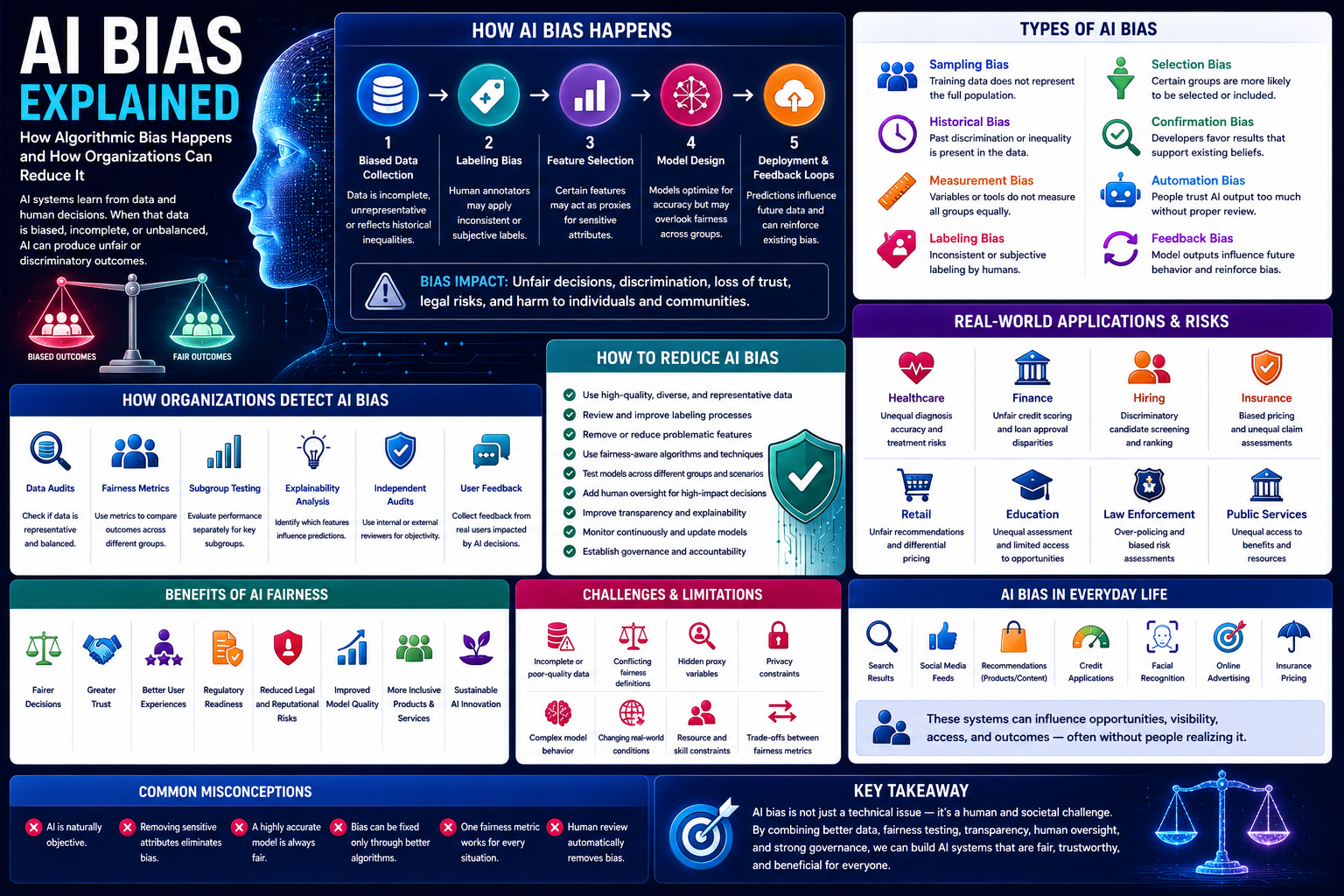
AI Bias Explained: How Algorithmic Bias Happens and How Organizations Can Reduce It
Introduction
Artificial Intelligence systems are increasingly used to support decisions in healthcare, banking, recruitment, education, insurance, retail, law enforcement, and public services. These systems can process enormous amounts of information quickly, but they do not automatically produce neutral or fair results.
An AI model learns from its training data, design choices, optimization objectives, and deployment environment. When those inputs contain incomplete, unbalanced, or historically biased patterns, the model may reproduce or amplify them.
This problem is known as AI Bias or Algorithmic Bias.
AI Bias can lead to unfair recommendations, inaccurate predictions, unequal access to services, and discriminatory outcomes. It can also expose organizations to legal, financial, operational, and reputational risks.
Understanding how bias enters AI systems is essential for building fair, transparent, and trustworthy Artificial Intelligence.
What Is AI Bias?
AI Bias occurs when an Artificial Intelligence system produces systematically unfair, inaccurate, or discriminatory outcomes for certain individuals or groups.
Bias may enter an AI system through:
Unrepresentative training data
Historical inequalities
Incorrect labels
Poorly chosen model features
Human assumptions
Inappropriate objectives
Deployment conditions
Feedback loops
AI Bias does not always result from intentional discrimination. It can emerge from subtle patterns within data or from technical decisions made during model development.
Why AI Bias Matters
AI systems can influence decisions that significantly affect people's lives.
Biased AI may contribute to:
Unfair hiring decisions
Unequal credit access
Inaccurate medical recommendations
Discriminatory insurance pricing
Unbalanced content recommendations
Incorrect identity verification
Unfair educational assessments
Reduced public trust
Organizations must address bias to protect users and maintain responsible AI practices.
How AI Bias Happens
AI Bias can enter at almost any stage of the AI lifecycle.
1. Biased Data Collection
The collected dataset may not represent the full population or real-world environment.
2. Historical Bias
Training data may reflect past inequalities or discriminatory practices.
3. Labeling Bias
Human annotators may apply inconsistent assumptions when categorizing data.
4. Feature Selection
Some variables may indirectly represent sensitive characteristics or social inequalities.
5. Model Design
Optimization choices may prioritize overall accuracy while overlooking performance differences between groups.
6. Deployment Bias
A model may be used in an environment that differs from the conditions under which it was trained.
7. Feedback Loops
AI-generated outcomes may influence future data, reinforcing the model's existing behavior.
Common Types of AI Bias
Several forms of bias can affect Artificial Intelligence systems.
Sampling Bias
The training dataset does not accurately represent the target population.
Selection Bias
Certain individuals, groups, or outcomes are more likely to be included in the data.
Measurement Bias
The variables or tools used to collect information do not measure all groups equally.
Labeling Bias
Human-generated labels contain inconsistent or subjective judgments.
Historical Bias
Past discrimination or inequality is reflected in the training data.
Confirmation Bias
Developers may favor results that support existing assumptions.
Automation Bias
People may trust an AI recommendation too readily simply because it was generated by a machine.
Feedback Bias
Model outputs influence future behavior and reinforce existing patterns.
AI Bias vs Human Bias
AI Bias
Human Bias
Embedded in data and algorithms
Influenced by beliefs and experiences
Can scale across millions of decisions
Usually affects individual decisions
May be difficult to detect
May be visible through behavior
Can repeat consistently
May vary between people
Requires technical and organizational controls
Requires awareness and behavioral change
AI Bias often originates from human systems, decisions, and historical data. Addressing it therefore requires both technical solutions and organizational responsibility.
How Organizations Detect AI Bias
Bias detection requires continuous testing throughout the AI lifecycle.
Data Audits
Evaluate whether datasets adequately represent relevant populations and situations.
Fairness Metrics
Measure differences in model outcomes across groups.
Common fairness measures include:
Demographic parity
Equal opportunity
Equalized odds
Predictive parity
Error-rate comparison
Subgroup Testing
Evaluate model performance separately across different populations and use cases.
Explainability Analysis
Identify which features influence model predictions.
Independent Audits
Use internal or external reviewers to evaluate AI systems objectively.
User Feedback
Collect reports from people affected by AI-generated decisions.
Continuous Monitoring
Track fairness and performance after deployment because bias may emerge over time.
How to Reduce AI Bias
Organizations can reduce AI Bias through a combination of technical and governance practices.
Improve Data Quality
Use representative, accurate, balanced, and properly documented datasets.
Review Labels
Apply clear annotation guidelines and quality-control procedures.
Remove Problematic Features
Evaluate whether model inputs directly or indirectly introduce unfair discrimination.
Use Fairness-Aware Training
Apply techniques that balance model performance with fairness objectives.
Test Across Groups
Measure accuracy, false-positive rates, and false-negative rates for relevant populations.
Add Human Oversight
Require human review for uncertain or high-impact decisions.
Improve Explainability
Help reviewers understand why the model produced a particular result.
Monitor Continuously
Detect performance drift, changing data patterns, and emerging disparities.
Establish Governance
Assign clear accountability for fairness, risk management, and incident response.
Real-World Applications and Risks
AI Bias can affect many industries.
Healthcare
Potential risks include:
Unequal diagnostic accuracy
Underrepresentation in medical datasets
Inappropriate treatment recommendations
Finance
Potential risks include:
Unfair credit scoring
Unequal loan approvals
Biased fraud detection
Human Resources
Potential risks include:
Discriminatory candidate ranking
Biased resume screening
Unequal promotion recommendations
Insurance
Potential risks include:
Unfair pricing
Biased risk assessment
Unequal claim processing
Retail
Potential risks include:
Unequal product recommendations
Biased dynamic pricing
Exclusion from promotional offers
Public Services
Potential risks include:
Unequal resource allocation
Biased eligibility assessments
Disproportionate automated scrutiny
Benefits of AI Fairness
Reducing AI Bias provides important benefits.
These include:
Fairer decisions
Greater public trust
Better customer experiences
Improved regulatory readiness
Reduced legal exposure
Higher model quality
More inclusive products
Stronger organizational reputation
Fairness improvements can also reveal weaknesses that affect overall AI performance.
Challenges and Limitations
Eliminating AI Bias completely is difficult.
Common challenges include:
Incomplete datasets
Conflicting fairness definitions
Hidden proxy variables
Historical inequalities
Limited demographic information
Privacy restrictions
Complex model behavior
Changing real-world conditions
Improving one fairness metric may sometimes reduce another. Organizations must choose appropriate definitions based on the context, affected users, and potential risks.
AI Bias in Everyday Life
People may encounter AI Bias through:
Search results
Social media feeds
Product recommendations
Credit applications
Recruitment platforms
Facial recognition
Insurance pricing
Online advertising
These systems can influence opportunities, visibility, access, and user experiences even when people are unaware that AI is involved.
Future of AI Fairness
Future developments may include:
Automated bias detection
Real-time fairness monitoring
More representative datasets
Fairness-aware foundation models
Standardized AI audits
Stronger regulatory requirements
Independent algorithm assessments
Improved human-AI review systems
AI fairness will become increasingly integrated into model development, governance, and compliance processes.
Common Misconceptions
Several myths surround AI Bias.
Common misconceptions include:
AI is naturally objective.
Removing sensitive attributes eliminates bias.
A highly accurate model is always fair.
Bias can be fixed only through better algorithms.
One fairness metric works for every use case.
Human review automatically removes unfairness.
In reality, AI fairness requires careful data management, technical evaluation, governance, stakeholder participation, and continuous monitoring.
Final Thoughts
AI Bias is one of the most important challenges in responsible Artificial Intelligence. Because AI systems learn from human-created data and operate within existing social and business environments, they may reproduce or amplify unfair patterns unless organizations actively manage those risks.
By improving data quality, measuring fairness, testing across groups, using explainability tools, adding human oversight, and continuously monitoring deployed models, organizations can develop AI systems that are more accurate, inclusive, and trustworthy.
Fair AI is not achieved through a single technical fix. It requires ongoing collaboration among developers, domain experts, legal teams, business leaders, regulators, and the people affected by automated decisions.
Frequently Asked Questions
What is AI Bias?
AI Bias occurs when an Artificial Intelligence system produces systematically unfair, inaccurate, or discriminatory outcomes for certain individuals or groups.
What causes AI Bias?
Common causes include unrepresentative data, historical inequalities, incorrect labels, inappropriate features, model-design choices, deployment conditions, and feedback loops.
Can AI Bias be eliminated completely?
It is difficult to eliminate every form of bias. Organizations can reduce and manage bias through better data, fairness testing, explainability, human oversight, governance, and continuous monitoring.
Is AI Bias the same as human bias?
No. Human bias arises from beliefs, experiences, and social influences, while AI Bias appears through data, algorithms, objectives, and system design. However, human and historical biases often contribute to AI Bias.
Which industries are most affected by AI Bias?
AI Bias is especially important in healthcare, finance, insurance, recruitment, education, public services, retail, cybersecurity, and other areas where automated decisions significantly affect people.
Comments (0)