
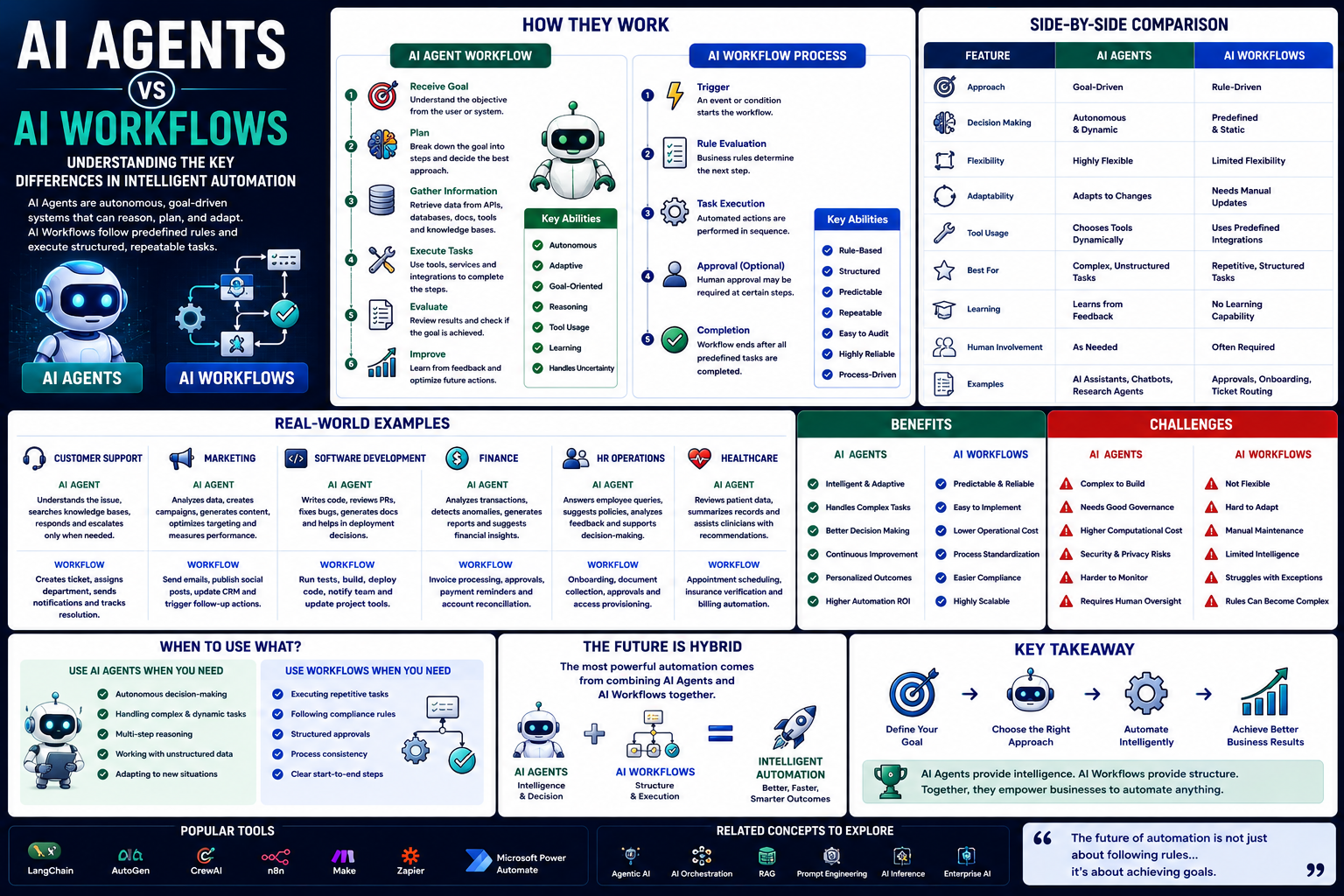
AI Agents vs AI Workflows Explained: Understanding the Key Differences in Intelligent Automation
Introduction
Artificial Intelligence is transforming business automation by enabling organizations to complete tasks faster, reduce operational costs, and improve customer experiences. Two concepts frequently discussed in enterprise AI are AI Agents and AI Workflows.
Although these terms are sometimes used interchangeably, they represent different approaches to automation.
AI Workflows automate predefined sequences of tasks using business rules, while AI Agents can reason, plan, make decisions, use external tools, and adapt their actions based on changing situations.
Understanding the difference helps organizations choose the right solution for customer support, software development, finance, healthcare, marketing, manufacturing, and countless other business processes.
What Are AI Agents?
AI Agents are intelligent software systems designed to achieve specific goals by making decisions, planning actions, interacting with tools, and adapting to new information.
Unlike traditional automation, AI Agents are not limited to fixed instructions.
They can:
Understand objectives
Break tasks into smaller steps
Use APIs and enterprise software
Search internal knowledge bases
Interact with databases
Collaborate with other AI agents
Learn from feedback
Adjust strategies when conditions change
AI Agents are designed for autonomous problem-solving rather than simple task execution.
What Are AI Workflows?
AI Workflows are structured automation processes that execute predefined business tasks according to rules and conditions.
Each step follows a planned sequence.
Examples include:
Invoice approvals
Employee onboarding
Email routing
Customer ticket assignment
Purchase approvals
Marketing campaigns
CRM updates
Payment processing
AI Workflows excel at repetitive, predictable business operations.
Why This Comparison Matters
Choosing the right automation approach directly impacts business performance.
Understanding the strengths of AI Agents and AI Workflows helps organizations:
Improve operational efficiency
Reduce manual work
Increase automation accuracy
Lower operational costs
Enhance customer satisfaction
Scale enterprise AI
Improve decision-making
Support business growth
Many organizations combine both approaches to maximize productivity.
How AI Agents Work
Most AI Agents follow an intelligent decision cycle.
1. Receive a Goal
The user or business defines an objective.
Examples include:
Prepare a financial report
Resolve customer issues
Analyze sales performance
Generate marketing content
2. Plan the Solution
The agent determines the steps required to achieve the objective.
3. Gather Information
The agent retrieves information from:
APIs
Databases
Documents
Knowledge bases
Enterprise software
4. Execute Tasks
The agent performs actions using available tools and services.
5. Evaluate Results
The system checks whether the objective has been completed successfully.
6. Improve Performance
The agent incorporates feedback into future decisions.
How AI Workflows Work
AI Workflows follow predefined logic.
1. Trigger
An event starts the workflow.
Examples include:
New customer inquiry
Invoice received
Employee registration
Purchase request
2. Rule Evaluation
Business rules determine the next step.
3. Task Execution
Automated actions are performed.
Examples include:
Sending emails
Updating CRM records
Creating tickets
Assigning approvals
4. Human Approval (Optional)
Certain workflows require manager or administrator approval.
5. Completion
The workflow ends after all predefined tasks have been completed.
Unlike AI Agents, workflows do not independently change their execution strategy.
AI Agents vs AI Workflows
AI Agents
AI Workflows
Goal-driven
Rule-driven
Autonomous decision-making
Predefined execution
Adaptive behavior
Fixed sequence
Uses reasoning
Uses business rules
Can choose tools dynamically
Uses predefined integrations
Handles uncertainty
Best for repetitive processes
Learns from feedback
Limited adaptability
Ideal for complex automation
Ideal for structured automation
Both approaches serve different business needs and often work together.
Real-World Applications
AI Agents and AI Workflows are widely used across industries.
Customer Support
AI Agent
Understands customer intent
Searches knowledge bases
Generates personalized responses
Escalates complex issues
Workflow
Creates support tickets
Assigns departments
Sends notifications
Tracks resolution status
Marketing
AI Agent
Generates campaigns
Optimizes audience targeting
Creates content
Measures campaign performance
Workflow
Sends scheduled emails
Publishes social media posts
Updates CRM contacts
Healthcare
AI Agent
Assists clinical decision-making
Reviews medical records
Summarizes patient history
Workflow
Appointment scheduling
Patient registration
Billing automation
Software Development
AI Agent
Writes code
Reviews pull requests
Suggests optimizations
Generates documentation
Workflow
CI/CD pipelines
Automated testing
Deployment approvals
Benefits of AI Agents and AI Workflows
Organizations gain different advantages from each approach.
Benefits of AI Agents
Intelligent decision-making
Greater flexibility
Dynamic problem-solving
Multi-step reasoning
Improved productivity
Better customer experiences
Continuous adaptation
Autonomous execution
Benefits of AI Workflows
Predictable execution
Easy compliance
Faster implementation
Lower operational costs
Reliable automation
Process standardization
Easier auditing
High scalability
Combining both approaches often delivers the best results.
Challenges and Limitations
Despite their advantages, both technologies present challenges.
AI Agents
Governance requirements
Security risks
Hallucinations
Monitoring complexity
Higher implementation costs
Human oversight requirements
Ethical considerations
Integration challenges
AI Workflows
Limited flexibility
Manual updates
Rule maintenance
Poor handling of unexpected situations
Limited reasoning
Complex workflow management
Proper planning and governance help organizations overcome these challenges.
AI Agents and Workflows in Everyday Business
Many organizations already rely on both technologies.
Examples include:
Online customer support
Banking automation
HR onboarding
Insurance claims
Inventory management
Logistics planning
IT help desks
Enterprise document processing
Most modern enterprise automation combines intelligent agents with structured workflows.
Future of Intelligent Automation
Future developments include:
Multi-agent collaboration
Hybrid AI Agent + Workflow platforms
Autonomous business operations
Self-optimizing workflows
AI orchestration platforms
Human-AI collaboration
Industry-specific AI agents
Enterprise autonomous systems
The future of automation will increasingly combine structured workflows with intelligent autonomous agents.
Common Misconceptions
Several myths surround AI Agents and AI Workflows.
Common misconceptions include:
AI Agents replace workflows completely.
Workflows can think like AI Agents.
AI Agents require no human oversight.
AI Workflows are becoming obsolete.
Every business needs autonomous AI.
In reality, both technologies complement each other and solve different automation challenges.
Final Thoughts
AI Agents and AI Workflows are complementary technologies that enable organizations to automate business operations more effectively. While AI Workflows provide reliable, rule-based automation for structured processes, AI Agents introduce reasoning, adaptability, and autonomous decision-making for more dynamic challenges.
As enterprise AI continues to evolve, businesses that successfully combine both approaches will be better positioned to improve productivity, reduce operational costs, enhance customer experiences, and build scalable intelligent automation systems.
Frequently Asked Questions
What is the difference between AI Agents and AI Workflows?
AI Agents make autonomous decisions and adapt to changing situations, while AI Workflows execute predefined tasks based on business rules.
Which is better for business automation?
It depends on the use case. AI Workflows are ideal for repetitive processes, while AI Agents are better for complex, goal-oriented tasks requiring reasoning and adaptability.
Can AI Agents and AI Workflows work together?
Yes. Many enterprise AI solutions combine AI Agents for intelligent decision-making with AI Workflows for structured execution and compliance.
Which industries use AI Agents and AI Workflows?
Healthcare, finance, manufacturing, retail, logistics, education, legal services, customer support, and software development all benefit from both technologies.
Do AI Agents replace human workers?
No. AI Agents are designed to assist humans by automating repetitive or complex tasks while people continue providing oversight, strategy, and final decision-making where appropriate.
Comments (0)