
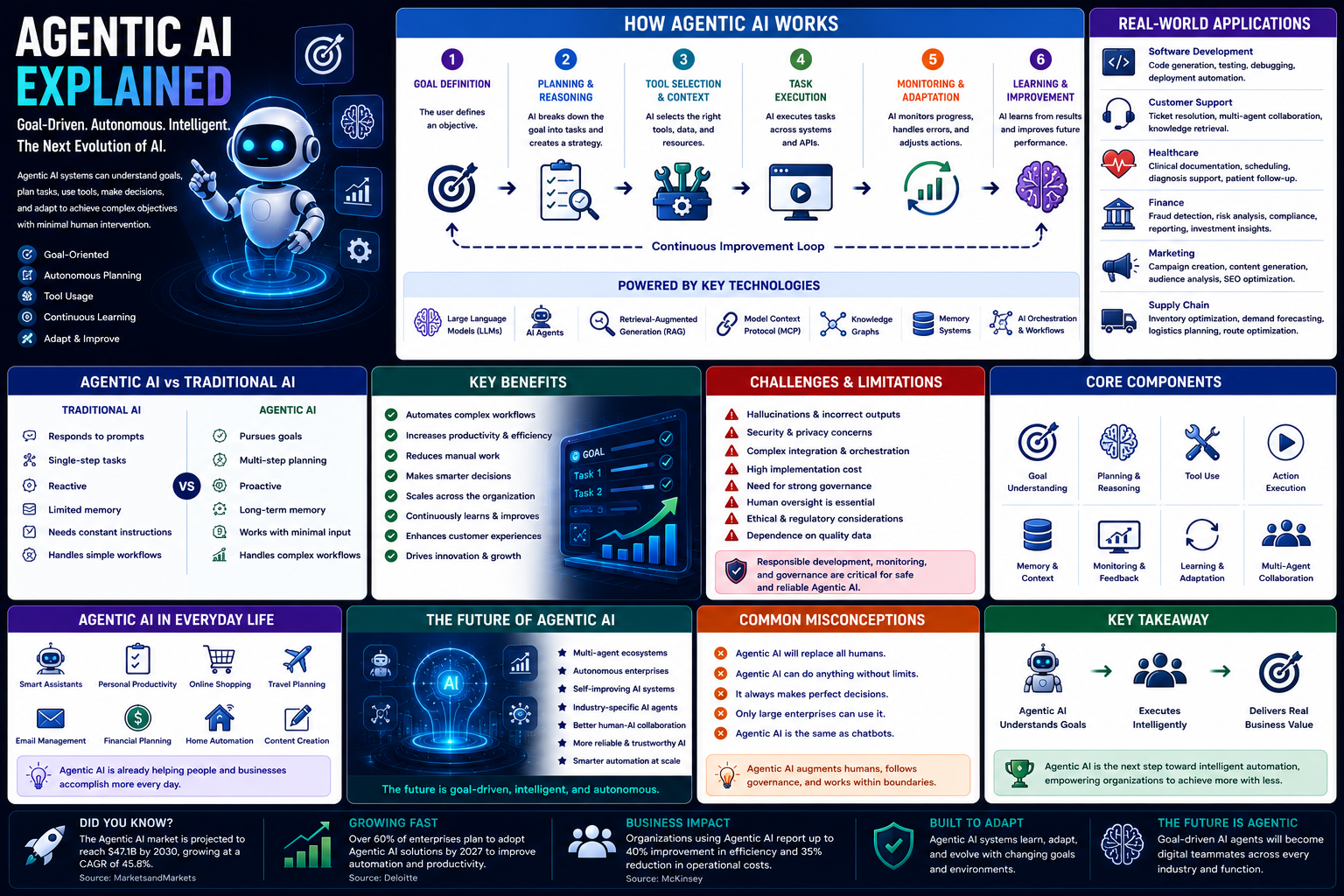
Agentic AI Explained: How Goal-Driven Artificial Intelligence Is Transforming the Future of Automation
Introduction
Artificial Intelligence has evolved from answering questions and generating content to completing sophisticated tasks with minimal human guidance. The next major step in this evolution is Agentic AI.
Unlike traditional AI systems that simply respond to prompts, Agentic AI is designed to pursue goals. It can plan, reason, make decisions, use external tools, collaborate with other AI agents, and adapt its behavior based on changing conditions.
Rather than waiting for step-by-step instructions, Agentic AI can independently determine how to achieve an objective while keeping humans involved for oversight and critical decisions.
As businesses increasingly automate complex workflows, Agentic AI is becoming a key technology for enterprise productivity, intelligent automation, software development, research, customer support, and decision-making.
What Is Agentic AI?
Agentic AI refers to Artificial Intelligence systems that can independently pursue goals by planning, reasoning, executing actions, learning from outcomes, and adapting over time.
Unlike conventional AI assistants, Agentic AI is proactive rather than reactive.
Agentic AI systems can:
Understand objectives
Break goals into smaller tasks
Choose appropriate tools
Execute workflows
Monitor progress
Recover from failures
Collaborate with other agents
Improve future performance
This enables AI to solve complex, multi-step problems with greater autonomy.
Why Agentic AI Matters
Modern organizations need AI that goes beyond answering questions.
Agentic AI helps by:
Automating complex business processes
Reducing repetitive work
Improving productivity
Accelerating decision-making
Coordinating multiple AI systems
Increasing operational efficiency
Supporting continuous optimization
Scaling intelligent automation
It enables organizations to move from simple AI assistance to intelligent goal execution.
How Agentic AI Works
Most Agentic AI systems operate through a continuous decision cycle.
1. Goal Definition
A user or business defines the desired objective.
Examples include:
Build a marketing campaign
Analyze customer feedback
Develop software features
Optimize inventory
Prepare executive reports
2. Planning
The AI breaks the objective into manageable subtasks and determines the best strategy.
3. Tool Selection
The system identifies and connects to appropriate resources.
Examples include:
APIs
Databases
Enterprise applications
Search engines
CRM systems
ERP platforms
File storage
4. Task Execution
Agentic AI performs the required actions across multiple systems.
Examples include:
Writing content
Running analyses
Updating records
Generating reports
Calling APIs
Scheduling meetings
5. Monitoring
The AI evaluates progress, detects problems, and adjusts its approach when necessary.
6. Learning and Improvement
Feedback helps the system improve future planning and decision-making.
Core Components of Agentic AI
Several technologies enable Agentic AI.
Large Language Models (LLMs)
Support reasoning and communication.
AI Agents
Perform specialized tasks.
Model Context Protocol (MCP)
Provides secure access to enterprise tools.
Retrieval-Augmented Generation (RAG)
Retrieves relevant information.
Knowledge Graphs
Provide structured relationships and context.
Memory Systems
Retain context across long-running tasks.
AI Orchestration
Coordinates multiple agents, workflows, and services.
Agentic AI vs Traditional AI
Traditional AI
Agentic AI
Responds to prompts
Pursues goals
Single-step tasks
Multi-step planning
Limited reasoning
Continuous reasoning
Reactive
Proactive
Human-directed
Goal-directed with oversight
Agentic AI extends traditional AI by combining planning, execution, and adaptation.
Real-World Applications
Agentic AI is transforming many industries.
Software Development
Code generation
Testing
Debugging
Deployment automation
Customer Support
Ticket resolution
Knowledge retrieval
Multi-channel assistance
Finance
Risk monitoring
Compliance automation
Financial reporting
Healthcare
Clinical workflow automation
Medical documentation
Patient scheduling
Marketing
Campaign creation
Audience analysis
Content optimization
Supply Chain
Inventory optimization
Demand forecasting
Logistics planning
Benefits of Agentic AI
Organizations gain significant advantages.
Benefits include:
Greater productivity
Intelligent automation
Faster execution
Better decision-making
Continuous optimization
Reduced manual work
Improved scalability
Enhanced customer experiences
Agentic AI enables organizations to automate increasingly complex operations.
Challenges and Limitations
Despite its potential, Agentic AI introduces challenges.
These include:
Hallucinations
Security risks
Privacy concerns
Human oversight requirements
Regulatory compliance
Ethical decision-making
Integration complexity
Infrastructure costs
Strong governance and monitoring remain essential.
Agentic AI in Everyday Life
Many emerging technologies already use Agentic AI concepts.
Examples include:
Enterprise AI assistants
Intelligent research tools
Smart customer service
AI coding assistants
Personal productivity assistants
Business workflow automation
Healthcare scheduling
Financial planning systems
Agentic AI is becoming increasingly common across digital workplaces.
Future of Agentic AI
Future developments include:
Multi-agent collaboration
Self-improving AI systems
Autonomous enterprises
Personalized AI workforces
Industry-specific AI agents
Smarter enterprise automation
Human-AI collaboration
Responsible autonomous decision-making
Agentic AI is expected to become one of the defining technologies of the next decade.
Common Misconceptions
Several myths surround Agentic AI.
Common misconceptions include:
Agentic AI replaces humans.
It operates without any rules.
Agentic AI always makes perfect decisions.
Only large companies can use Agentic AI.
Agentic AI is the same as chatbots.
In reality, Agentic AI is designed to augment human capabilities while operating within governance, security, and ethical frameworks.
Final Thoughts
Agentic AI marks a significant shift in the evolution of Artificial Intelligence by enabling systems to move beyond passive assistance toward proactive, goal-driven execution. By combining reasoning, planning, memory, orchestration, and continuous learning, Agentic AI empowers organizations to automate increasingly complex workflows while maintaining human oversight and governance.
As businesses continue investing in intelligent automation, Agentic AI will play a central role in shaping the future of digital work, enterprise productivity, and human-AI collaboration.
Frequently Asked Questions
What is Agentic AI?
Agentic AI refers to AI systems that can independently plan, reason, execute tasks, and adapt while working toward defined goals.
How is Agentic AI different from AI Copilots?
AI copilots primarily assist users, while Agentic AI actively plans and executes multi-step workflows with greater autonomy.
Which industries use Agentic AI?
Healthcare, finance, software development, manufacturing, logistics, retail, customer service, education, and many other industries.
Does Agentic AI replace human workers?
No. Agentic AI is intended to automate repetitive and complex tasks while humans provide oversight, strategy, and accountability.
Why is Agentic AI important?
It enables organizations to automate sophisticated workflows, improve productivity, enhance decision-making, and scale intelligent business operations.
Comments (0)